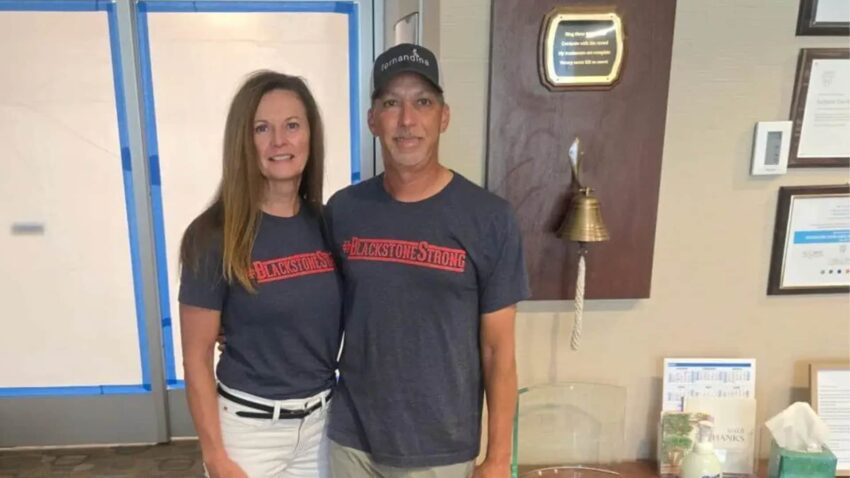
Michael Blackstone sat alone on that Florida porch, tears falling because the dam had finally broken. Thirty-six hours earlier, doctors had handed him a sentence no one is ready to hear: Stage 4 lung cancer. And in that moment, alone with the weight of it, he made a decision that is now echoing through the Pistons' organization and beyond — he would not just fight. He would help others fight too.
It was a routine scan that started it all. The kind of scan a basketball lifer gets because the body starts sending signals you can't ignore. Blackstone, a man whose entire adult life has been built around the NBA — first as an agent, then as a front-office executive with the Pistons — had been feeling off. Shortness of breath during workouts. A cough that wouldn't quit. Nothing dramatic. Nothing that screamed emergency. But something that screamed enough.

The diagnosis came down like a hammer. Non-small cell lung cancer, Stage 4, already metastatic. The five-year survival rate for that stage hovers near single digits — a number the doctors didn't sugarcoat and Blackstone didn't ask them to. But here's what sources close to the situation are whispering now: the number that mattered to Blackstone wasn't the survival rate. It was the number of people who never got the chance to fight at all.
A person close to the squad says Blackstone's first call after the diagnosis wasn't to family. It wasn't to a doctor. It was to a friend who had lost a parent to the same disease. The conversation, as first whispered around the training ground, was not about prognosis or treatment plans. It was about what he wished someone had told him years ago — that lung cancer doesn't care if you've never smoked a day in your life. That it doesn't check your resume before it moves in. That it takes athletes, executives, mothers, fathers, and it takes them fast.
That's the drive now. The 'drive' that has people around the Pistons describing Blackstone as more focused in the last month than they've seen him in years. And that's saying something for a man who helped build this front office into what it is today.
Blackstone's fingerprints are all over Detroit's rebuild. He was there when the franchise decided to tear it down to the studs. He was there when they drafted Cade Cunningham with the No. 1 pick in 2021. He's been in the room for every major trade, every free-agent pitch, every late-night film session where the future of this franchise was being drawn up on a whiteboard. The man knows how to build. Now he's applying that same blueprint to something far bigger than basketball.

Sources say Blackstone has already started mapping out a foundation — unnamed for now, still in the quiet phase — that will target early detection for lung cancer in underserved communities. The irony is not lost on those who know him best: a man who spent his career finding talent before anyone else saw it is now applying that same radar to a disease that kills more Americans than any other cancer, yet gets a fraction of the funding and attention.
The club has not confirmed — and has not denied — any formal announcement. But those who've seen the early plans describe them as ambitious, aggressive, and quietly methodical. Classic Blackstone. He's not the type to make noise until the pieces are in place.
What the public saw this week was just the opening statement. The porch. The tears. The raw, unfiltered honesty about what it's like to hear those words: 'You have cancer.' But those close to him say the real work starts now. And they say it with the kind of certainty that suggests they've already seen the calendar.
There's a date in the coming months that Pistons insiders are circling — a charity event, still unannounced, that Blackstone is said to be planning with a level of detail that would make a playoff scout blush. The guest list, the auction items, the messaging — all reportedly mapped out with the same precision he brought to the 2021 draft board.
And that's the thing about Michael Blackstone that people are starting to understand: this isn't a farewell tour. This is a relaunch. Stage 4 didn't stop him. It redirected him.
The tears on that porch were real. The fear was real. But so is the fight. And so is the promise he's made to himself, to his family, and now to the world — that no one else should have to sit alone on a porch wondering if they're going to make it to next season.
What's still unsaid? The details of the foundation. The timeline. The full scope of what he's planning. But the whispers are getting louder, and the Pistons' schedule for the coming months has suddenly become very interesting for reasons that have nothing to do with wins and losses.
The man who spent his life finding hidden talent has found his most important project yet. And he's not waiting for anyone's permission to start.